



Saturday, February 24, 2018


Friday, January 26, 2018
Sunday, December 03, 2017
OF RIFLES AND RIFLEMEN: THE MIGHTY FINNS

In the 1939-1940 Winter War, the Finns made good use of skis for mobility, white snow smocks for camouflage, and a tradition of marksmanship skills to savage the Russian bear.
Western academics being, in general, rather favorable towards
Communism, most Americans have only heard about a single threat to humanity
when the world stood on the brink of World War Two; Adolph Hitler and his Nazi
Party. At the time, however, the Soviet Union
was ruled by an equally power-mad, paranoid and blood-thirsty dictator by the
name of Joseph Stalin. The body count is so high that no one really knows, but
it has been estimated that Stalin’s state-sponsored famines, purges, secret
police and gulags killed at least twice as many Russian citizens as the Nazis
did during the course of the Second World War.
On August 23,
1939 the Soviet Union and Nazi Germany signed
the Molotov-Ribbentrop Non-aggression Pact. Although the Soviets did not
publicly acknowledge it until the late 1980’s, secret codicils within the
non-aggression pact divided the smaller nations of Eastern Europe up like so
many poker chips into “Spheres of Influence” that “belonged” to either the
Nazis or the Soviets.
On September 1st,
1939, Nazi Germany launched a swift invasion of Poland with its new style of
Blitzkrieg warfare that proved highly successful. Sixteen days later all hope
of continued resistance was crushed when the Soviet Union rolled across the
eastern borders of Poland
with 33 more divisions. As per yet another secret protocol of the
Molotov-Ribbentrop Pact, Poland
was divided along pre-determined boundaries between Germany
and Russia.

The 1939 Nazi-Soviet Non-aggression Pact included secret codicils in which Hitler and Stalin divided up the nations of Eastern Europe and the Baltic like so many poker chips.
Stalin wasted
no time in bringing the rest of his “sphere” under Soviet control. The Baltic
countries of Latvia, Lithuania and Estonia
were diplomatically blackmailed into signing “defense pacts” with the Soviet Union. Immediately afterwards, Soviet troops
quickly occupied all three countries to “defend” them, and their people, land
and resources were absorbed into the Soviet Union.
Only Finland
refused to give in to Soviet demands. This, in itself, took considerable balls.
At the time, Finland
encompassed 149,000 square miles and had a population of less than four million
people, smaller than the city of Leningrad by itself,
while the Soviet Union stretched across two
continents and occupied 8,649,500 square miles, almost of sixth of the Earth’s
land mass, and had a population of 180,000,000. A military contest between the
two nations was likened to David and Goliath.


The Soviets
were more than happy to resort to military force when diplomatic arm-twisting
failed. In an almost ludicrously transparent false flag operation, Red Army
artillery bombarded the Russian border village of Mainila.
The Soviets claimed tiny Finland
had attacked them and they were forced, in self defense, to immediately
launched massive well-prepared invasions at numerous points along the 800 mile
long Finnish border. By the end of the 100-day war, the Russian colossus would
commit four times the men, guns,
tanks and planes that the combined Western Allies mustered for the D-Day
invasion of Normandy
in 1944. In total, 58 Soviet divisions were committed. Against them, the Finns
could muster only ten divisions ill-equipped with modern or heavy weapons.
In the initial
attacks, the Red Army would use more than 2,500 tanks, the most numerous models
being the T-26 light infantry tank and the BT fast tanks, but also including
behemoths like the multiple-turret T-28 medium and a few of the new heavily
armored KV-1 heavy tanks. The Finns possessed only a handful of old WWI-vintage
French Renaults and a few recently acquired British Vickers 6-ton light tanks
whose weapons had not even been installed at the start of the war. Although the
Finnish Defense Forces had adopted the modern Swedish Bofors 37-mm anti-tank
gun, less than 50 were in service at the beginning of the war. Lacking any
other means, Finnish soldiers had to learn on-the-job to attack Soviet armor in
close-range infantry assaults using demolition charges and the ultimate poor
man’s anti-tank weapon, the Molotov cocktail.
In the air,
the Red Air Force brought in more than 3,800 aircraft, including some of its
best and most modern types such as the Tupolev SB, Ilyushin DB-3, and the
stubby but fast and well-armed Polikarpov I-16. Opposing them, the tiny Finnish
Air Force could muster a grand total of 114 aircraft of all types, many of
which were old and out-dated aircraft, fabric-covered biplanes from the 1920’s
like the Bristol Bulldog, Blackburn Ripon, and Fokker C.V. While the Finns had
begun to acquire some modern anti-aircraft guns such as the Swedish Bofors
40-mm and Czech Skoda 75-mm guns and their ack-ack gunners would prove to be
quite accurate, there were always too few guns available to properly defend
even the larger cities let alone the field armies.
Artillery has
traditionally been a Russian military strong suite and the Winter War was no
exception. The guns included modern 120-mm heavy mortars and their excellent
76.2-mm field guns and went all the way up to the colossal B-4 203-mm super
heavy howitzer capable of hurling a 220-pound shell to a range of ten miles. A
Soviet infantry regiment boasted three times the number of supporting artillery
pieces as a Finnish regiment and in general enjoyed unlimited ammunition supply.
What artillery the Finns could muster was often quite old--fully a third of
their entire artillery park consisted of old Tsarist Russian Model 1902 76-mm
field guns—and calls for fire were limited by a lack of radio communication
gear below the regimental level. Even for the weapons on hand the Finns had
only a 21-day supply of artillery shells stockpiled.
The naval
equation was, of course, just as lopsided. The Soviet Baltic Fleet boasted two
battleships, a heavy cruiser, nearly 20 destroyers, fifty motor torpedo boats,
and 52 submarines, plus assorted smaller ancillary craft. The Finnish Navy had
two fairly modern coastal defense ships, five submarines, four gunboats, seven
motor torpedo boats, one minelayer and six minesweepers. The Finns also possessed
some fortified coastal artillery batteries but only a few had modern
fortifications, guns and fire control gear while the vast majority were
old-fashioned left-overs from the Tsarist Russian period.
Red Army troops involved in the Winter War ran the gamut from crack modern mechanized divisions to hastily recalled conscript reservists who had not fired a rifle in three years. Many were ill-prepared and equipped for Arctic winter conditions. The greatest handicap, however, was in leadership. Always paranoid about any potential rivals for his position, one of Joseph Stalin's many purges decimated the highest ranks of the Red Army in 1937. Falling beneath the axe were three of five marshals, 13 of 15 army commanders, 50 of 57 corps commanders, and 154 of 186 divisional commanders. Soviet Army units at the time also had attached "coequal" political commissar officers who could contradict, over-rule or, in extreme cases, even execute military commanders in the field.
Red Army troops involved in the Winter War ran the gamut from crack modern mechanized divisions to hastily recalled conscript reservists who had not fired a rifle in three years. Many were ill-prepared and equipped for Arctic winter conditions. The greatest handicap, however, was in leadership. Always paranoid about any potential rivals for his position, one of Joseph Stalin's many purges decimated the highest ranks of the Red Army in 1937. Falling beneath the axe were three of five marshals, 13 of 15 army commanders, 50 of 57 corps commanders, and 154 of 186 divisional commanders. Soviet Army units at the time also had attached "coequal" political commissar officers who could contradict, over-rule or, in extreme cases, even execute military commanders in the field.
The entire
watching world expected a rapid, smashing victory like the Blitzkrieg of Poland.
Thus everyone, including many Finns, were stunned when, after the first month
of heavy combat, the ill-equipped and grossly out-numbered Finnish Defense
Forces had essentially fought the gigantic Russian bear to a standstill. Although
the Western democracies expressed great admiration and support for the tiny
Finnish David attempting to slay the gigantic Russian Goliath, said support
consisted almost entirely of politicians spouting words in lieu of weapons,
ammunition, or men.
A Finnish word helps to explain their
stubborn resistance in the face of overwhelming odds; sisu. The word sisu does
not translate directly into English, but can be summed up variously as courage,
bravery, or guts. With a nod to John Wayne, I liked to translate it as “True
Grit.” As but one example, when the avalanche of Soviet troops first poured
towards the thin outpost line of Finnish border troops during the opening of
the offensive, some nameless Finnish soldier, with a combination of military
gallows humor and a good dose of sisu
made a comment that would become something of a catch-phrase about the Winter
War. “So many Russians. Where will we bury them all?”


The Finns were also, as a people,
completely united together against this Russian aggression of their homeland. Even
the fairly large number of Finnish Communist Party members quickly and eagerly
answered their nation’s call to colors. The Soviets almost immediately installed
and boasted about a Quisling-like puppet government which served only to enrage
and further unite Finns of all political stripes. With such a small population
to draw from, some 130,000 Finnish women became “Lottas.” The Lotta
Svärd was a volunteer auxiliary organization whose members filled important
jobs vacated by men called up for military service, served in hospitals, manned
the air raid warning system, and performed other military support tasks to free
up men for the fighting front.
Across large portions of Finland, the
land itself aided the defense; vast expanses of thick conifer forest, muskeg,
and an endless maze of rivers and streams connecting nearly 200,000 lakes
restricted Soviet motorized and armored forces to the handful of existing and
easily ambushed roads. Nearly a third of the terrain lies north of the Arctic Circle so the bitter cold and snowfall also aided
the Finns. With a largely rural population and a scant road network, most Finns
learned how to cross-country ski at an early age. When the snows came, the
Finnish ski troops enjoyed a great advantage in mobility and speed while the
Soviet infantry was left to wallow slowly through the deep powder on foot.
Under ideal snow conditions, specialty ski troops such as reconnaissance
detachments and jaeger light infantry units could cover as much as 60
kilometers in a day. Orienteering, locating a fixed marker via compass and map,
had been a popular pre-war sport in Finland, and this skill also proved
of great military value. Many Finnish soldiers fought on intimately familiar
ground they had literally grown up on.
In his
excellent history of the Winter War, A
Frozen Hell, author William R. Trotter points out, “The forest itself
dictated a heavy emphasis on individual initiative and small-unit operations,
quasi-guerilla style. Marksmanship, mental agility, woodcraft, orienteering,
camouflage, and physical conditioning were stressed, and parade-ground niceties
were given short shrift.”[i]
The Finnish
military was armed primarily with the same Mosin-Nagant 7.62x54R bolt-action rifles
as their Soviet opponents, having captured vast stocks of them when they
declared their independence during the chaos of the Russian Revolution. The
design of the weapon itself dated back to 1891. The basic rifle was over 48
inches long, with a barrel length just under 29 inches, and an empty weight of
about 9 pounds. The bolt action featured a straight bolt handle and the
five-shot integral box magazine had a steel well that protruded beneath the
stock.
The standard captured Russian weapons
were, of course, not good enough for the Finns with their passion for shooting
and accuracy. They quickly set about on a program to improve their
Mosin-Nagants, culminating with the M39, which soldiered on in Finnish military
service for training and reserve use into the 1970s. Both Finland
and the Czech Republic still issue Army sniper rifles
built around M91 Mosin Nagant actions.

With little industry to equip an
army, the Finns instead made improvements and upgrades to their existing stock of captured Russian
Mosin-Nagant M/91 rifles, and the Finnish models are still regarded as the best of
the breed.
At the time of the Winter War, the
Finns had improved their stocks of basic '91 Mosin-Nagant rifles into the M1927
and the M1928/30 Mosin-Nagant, the latter still respected as the very best of
the entire M-N line. The Finns insisted on new and improved sights including an
adjustable flat-topped front blade sight which was, on the M1929/30, protected
by two heavy metal “ears”, which led to the Finns nicknaming the weapon the “Pystykorva" after a breed of dog
with similar erect ears.
Finnish Mosins were also re-barreled
with much better grades of steel, some of the barrels being made in Germany until Finland could produce her own. On
the m/28 rifles, the heavy, stiff Mosin trigger pieces were polished and fitted
with an additional spring to create a crisp take up in the trigger slack. The
m/28-30 went a step further and also re-shaped the trigger to create a better
pull. An aluminum sleeve around the barrel where it fit into the nosecap of the
forestock essentially “floated” the barrel for superior accuracy.
The 7.62x54R round had a rimmed
cartridge case like the British .303, so reloading was best accomplished with a
5-shot stripper clip since loading single cartridges without paying close attention
could lead to overlapping rims causing jams during feeding. The Finns produced
new magazines with “dimples” pressed into the metal, a simple modification that
largely prevented interlocking cartridge rims; these magazines were factory
marked “HV”, an abbreviation for a Finnish word which essentially translates as
“Jam Free.”
During WWII, Finnish 7.62x54R
ammunition was manufactured mostly by Sako and the VPT State Cartridge Factory,
now better known as Lapua. They used high quality materials and produced the
ammunition to tight specifications and it had a fine reputation for accuracy. The
refurbished Finnish Mosin-Nagants had to meet an accuracy test-fire standard of
no more than 1.3-inch groups at 100 meters before they were approved for
service.
The John Moses Browning of Finland, Aimo
Johannes Lahti, was a self-taught mechanical genius who was instrumental in
up-grading existing military weapons and designing new ones. In total, he
designed some fifty weapons ranging from pistols to anti-aircraft guns. These
included the M/26 Lahti-Saloranta light machine gun, intended to be the Finnish
Browning Automatic Rifle, and the L-35 9-mm automatic pistol, which remained
the standard Finnish sidearm until the 1980’s, and the intriguing L-39 20-mm
anti-tank rifle. His greatest masterpiece, however, is generally considered to
be the famous Model 31 Suomi 9mm submachine gun. This weapon so impressed the
Soviets during the Winter War that parts of its design, especially the 71-round
drum magazine, were widely copied in creating the Russian PPsH-41 “burp gun.” Finland’s stocks of various old Russian and
German-made Maxim water-cooled medium machine guns were being up-graded to Lahti’s Model 32-33
standard, considered the best of the Maxim line. Improvements included
metallic-link ammunition belts, a cyclic firing rate boosted to 850 rounds per
minute, and a large lid on the barrel’s water cooling jacket so Finnish gunners
could simply stuff handfuls of readily available snow into the gun to keep it
cool.
Finnish weapons were all noted for their
accuracy, and the average Finnish soldier knew well how to take advantage of
that virtue. Hunting and shooting competitions were both popular with the
largely rural population. Both the Finnish regular Army as well as the Civil
Guard also put great emphasis upon individual marksmanship. In particular, the
Finnish Civil Guard or Suojeluskunta
(Sk), similar only in certain aspects to the American National Guard concept,
devoted a great deal of time and effort to shooting. They built literally
hundreds of rifle ranges in small towns around the country, held frequent
shooting competitions, and tried to make shooting the national sport. During
the 1930’s their focus on sport shooting, i.e. firing the smallest groups at
known distances, shifted to emphasize more military-oriented events, which
stressed, in addition to accuracy, speed of fire and rapid reloading while
shooting at unknown distances. In this Combat Range
training, conventional paper bullseyes were replaced with mechanically-controlled
man-shaped silhouette targets which dropped when hit. Some ranges grew large enough to support
company-sized live-fire exercises, and one range could accommodate
regimental-sized live-fires.


Finland hosted the 1937 World Shooting Championships in Helsinki, with the Finnish rifle team and individual shooters winning the gold.
Beginning in 1897, the International
Shooting Sport Federation’s (ISSF) World Shooting Championships were held
either annually or bi-annually, except when interrupted by the two World Wars. From
1911 to 1962, the championships included the 300-meter Army Rifle Event, in
which all shooters were required to compete with the military-issue rifle of
the host nation. At the 1935 Championships in Rome, Italy,
the Finnish team came in first place as the medal count winner.
The World Shooting Championships were
hosted by Finland in Helsinki in 1937. Finnish
President P. E. Svinhufvud, himself an avid shooting competitor, personally led
the opening ceremonies for the event on July 30th. Using Civil Guard M/28-30
Mosin-Nagants, the Finnish rifle team walked away with the gold championship
cup, led by individual gold medal winner Olavi Elo, who set a new world record
in the International Army Matches. Shooting was also the national sport in Switzerland but two years later at the 1939
Swiss Shooting Festival (Schutzenfest)
in Lucerne,
although the Swiss Service Rifle Team edged out the Finnish team for first
place, the Finns captured the Free Rifle event, and the Estonian team captured
the medal count.
Individual
Finnish soldiers and snipers accomplished some impressive feats with their
upgraded Mosin-Nagants, most with just the standard open sights. One amazing
Finn stands out in particular as one of the greatest snipers of the Second
World War. Corporal Simo Haya, using an M/28 Mosin with standard open sights,
was credited with over 500 confirmed sniping kills before he was seriously
wounded and sent to hospital. He also accounted for around 200 more Russians
with a Suomi submachine gun in close range actions.

A Finnish sniper, well camouflaged and protected from the cold, waits
patiently for a Russian target.
It was not
just snipers who played a part in the Winter War, but the widespread marksmanship
skill of the ordinary infantry riflemen counted for a great deal as well.
Especially towards the latter part of the war when Finnish artillery and mortar
ammunition was nearly depleted, Soviet infantry assaults were repelled time and
again with “nothing more” than accurate small arms fire from rifles and machine
guns.
In a battle on frozen Lake Tolvajarvi,
three platoons of Finnish infantry under the command of Lieutenant Eero Kivela
ambushed an entire Russian battalion by themselves. The Finns had only their
rifles; their few Maxim machine guns had been left behind with another platoon
in defensive positions. The Russians soldiers were strung out across the pure
white expanse of the frozen lake, without any snow camouflage, their brown
uniforms making them easily identifiable targets. At first light, Kivela’s men
opened fire from their concealed positions. Caught in the open, the Soviets
were mown down by the intense, accurate rifle fire. When they managed to
retreat to the cover of the woods, they left behind at least 200 dead on the
ice.
Near the town
of Jehkila, a lone
Finnish automatic rifle team, well camouflaged, held up the advance of an
entire Soviet regiment for almost an hour by mowing down every Red Army soldier
or squad that attempted to push forward. In the Joutsijarvi sector in late
December, a Soviet company commander with the 122nd Division
recounted how his battalion made three separate frontal attacks across a frozen
lake in attempt to take a Finnish village. Each time, the Finnish defenders
chopped them to pieces with a deadly hail of small arms fire. At the end of the
second assault, the officer had only 38 men left standing from his entire
company. After the third and final assault, in excess of two-thirds of the
entire battalion lay dead on the ice.
In the fighting on the Kollaa Front, the Soviets attempted a
new tactic. Individual soldiers would advance behind an armored shield mounted
on skis, pushing it ahead of them as they crawled forward. An admiring Finnish
soldier described how a sniper in his unit dealt with one machine gun-armed
shield by shooting through the narrow firing slit. “There was an opening in the
shield about one half inch high and two and one half inches wide for aiming. I
could hardly see it, but obviously the man with the [sniper rifle] saw it
better. We heard a shot and the Russian’s helmet rolled on the ground.”

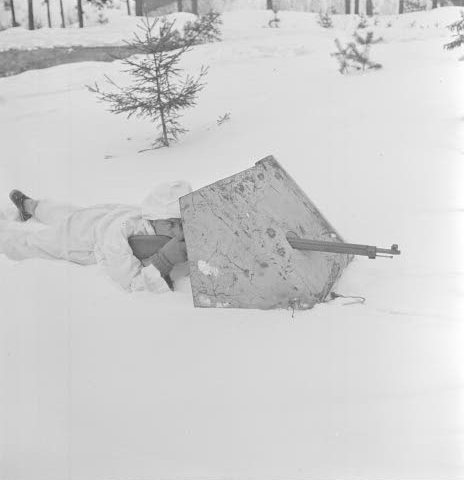
The Soviet introduction of ski-mounted armored shields for riflemen and machine gunners did not prove successful against Finnish sharpshooters.
Other Finnish
sharpshooters adopted the tactic of crawling silently ahead of their main line
of resistance and into No-Man’s Land to take out the men behind the armored
shields from the flanks, with shots to exposed legs and buttocks. In the brutal
combat defending the Mannerheim Line in the Summa area in mid-February, the
Soviets sent forward a large number of these armored sleds. A lone Finnish
lieutenant by the name of Kussala, equipped with a scoped sniper rifle,
slithered alone out into no-man’s-land and began hunting these sleds. In one
morning’s work, he took out fifteen such sleds by picking off the men behind
them before he had to retire to Finnish lines when he ran short of ammunition,
having to find shelter in an abandoned trench when a Soviet tank crew spotted
him and tried to run him over. The next day, Kussala took a volunteer group of
infantrymen with him on another such foray into No-Man’s Land. They returned in
possession of thirty Russian armored sleds which they put to use bolstering the
artillery-battered Finnish fighting positions.
In the far
north, two hundred miles north of the Arctic Circle, the Port
of Petsamo was Finland’s only harbor on the Arctic Sea
and the area contained the most productive nickel mines and largest smelter in Europe. Nickel being a vital component in the alloys used
to manufacture aircraft motors and submarine Diesel engines, this made the area
an important strategic target coveted by Allies and Axis alike. Petsamo was not
strongly garrisoned due to its sheer isolation from any other population
centers; 250 miles of the newly constructed Arctic Highway was the only tenuous land
connection to Roveneimi, the nearest city of any size and the railroad system.
Thus, Petsamo
was rather weakly defended by only a single company of Covering Troops
supported by one artillery battery of four ancient 1887-vintage field guns, the
76mm ammunition for which was so old that nearly half the rounds fired proved
to be duds. The Soviets attacked from land and sea, pouring in two full
infantry divisions supported by combat aircraft from Murmansk and heavy naval gunfire from the
fleet. The tiny Finnish garrison was, of course, quickly overwhelmed.
As December temperatures quickly
plunged to thirty below zero, the Soviets attempted to advance southwards on
the new Arctic Highway,
and the Finnish defenders fell back ahead of them with endless delaying tactics
and a “scorched earth” policy that left nothing of value to the invaders. This
was especially bitter for the Finns, who had painstakingly attempted to build
up their Arctic infrastructure over the previous two decades.
The Finnish Army could spare no
formations of regular troops from the desperate struggles on the Karelian Isthmus
and Lake Ladoga area, so the defenders were
mostly Civil Guardsmen and recalled reservists, and their numbers never
exceeded much more than battalion strength. But these men were also largely
hearty outdoorsmen…farmers, loggers, miners, trappers, fishermen, and
hunters…who were intimately familiar with and well acclimatized to the harsh
landscape that they called home. The Lapland Fells, a vast stretch of barren,
wind-swept treeless tundra, seemed to offer very little in the way of
concealment, cover or natural defensive terrain. The Finns were aided by the
cloak of darkness offered by the long Arctic nights, their greatly superior
mobility on skis, and their sharpshooting.
As Trotter put it, “Only rarely did
the Soviet invaders see an opponent; if they did, it was an instant’s
hallucination, a flickering blur of motion as a snow-suited guerilla flashed
across the grayed-out horizon. But there were sniping parties that contested
every kilometer of their advance, composed of Lapland
natives who had tracked bear and wolves over this same ground and who could
drill a man through the head at 1,000 meter with their first shot.”[i]


"The Finns were excellent shots."
While perhaps a bit over-stated, the Finnish riflemen really did take an incredible toll and exhibit superb shooting. During the Second World War, as supporting arms rather than small arms took over the lion’s share of destruction upon the enemy, the usual ratio of casualties ran to 4 wounded for every man killed. In his official after-action reports, Soviet commander General Valerian Forlov said, “The fighters were well prepared, and in some battles we lost more killed than wounded. To correlate the losses, there were 60 killed and 40 wounded per 100 [casualties]. The Finns were excellent shots.”
In addition to
sniping and delaying tactics, small Finnish units, usually of about platoon
strength, began to probe and strike deep behind enemy lines, attacking isolated
Red Army outposts, ambushing convoys on the Arctic Highway, and blowing up
supply dumps and bridges. By the time the war ended, the Soviet 14th
Army’s push southwards from Petsamo had essentially ground to a standstill. The
constant raids had forced the greatly superior attacking force to go on the
defensive, building a chain of fortified positions every 5-6 miles along the
highway and patrolling between these strongpoints with tanks just to keep the
only trafficable road open.
In heavily forested central Finland
near the town of Suomussalmi,
the Soviet 9th Army attacked westward with the intention of cutting
the entire country off at its narrow “waist” and some of the most famous and
punishing battles of the Winter War were fought there. Surrounded by dense
forest and inhospitable Finnish terrain, the first two Soviet divisions to
attack, the 163rd and 44th Rifle Divisions supported by a
tank brigade, were restricted to the only two trafficable routes; the
Juntusranta and Raate Roads. The two Russian columns combined had a strength of
nearly 50,000 men while at their peak the Finnish defenders numbered only
11,500.
In a series of
raids and battles large and small that lasted a full month, the vastly
outnumbered Finnish defenders first halted, then segmented and eventually
decimated the 163rd and 44th Divisions, whose vehicles,
artillery and armor kept them road-bound in two long, thin columns stretching
for miles. With what came to be called motti
tactics, the Finns began to fragment the Soviet column and then isolate and
destroy each pocket. Roughly translated, mottis
are Finnish “cords” of wood, stacked in separate piles through the woods,
waiting to be cut up into stove lengths. Although the Russians outnumbered the
Finns by a factor of four-to-one and possessed an overwhelming superiority in
tanks, artillery and aircraft, the Finns were able to use their skis for
greatly superior tactical mobility and were able to support their units via
hastily constructed “winter roads”, often utilizing frozen lakes and water
courses to travel on through the deep woods. Small, fast formations of
white-clad Finnish ski troops conducted endless hit-and-run attacks and
harassed the flanks of the stretched out 20-mile-long Red Army road-bound
column.
These shock
attacks from out of the snowy nights were often conducted by men armed with
Suomi submachine guns and grenades, but sharpshooters often accompanied them
with the express purpose of targeting Soviet officers. Likewise, during the
day, Finnish snipers waited patiently for hours in the cold to get a shot at a
Russian officer. Recalling the effectiveness of the Finnish snipers, one Soviet
officer wrote, “They were able to get their man at distances of 800 to 1,000
yards. They fired but rarely, and never missed.”
These constant attacks led Russian
Commander Vinogradov to believe he faced much larger Finnish forces than
actually existed. His 44th Division was forced to forgot about
relieving the 163rd a mere six air miles away and had to
concentrate…futilely, as it turned out…on just saving itself. Desperate to stay
alive in nighttime temperatures that could reach as low as -40 degrees
Fahrenheit, the Russian soldiers huddled around large open bonfires, making
easy targets for Finnish rifles reaching out from the edge of the dark forest. Counter-attacks
to break through the Finnish roadblocks to regroup the isolated units were
bloodily repulsed. In the cold, the radiators of the Russian motor vehicles
froze solid and motor oil congealed, disabling their tanks, trucks, and armored
cars, and even weapons lubricants thickened to make guns sluggish or
inoperable.

Two entire Soviet divisions, the 163rd and 44th, were decimated in the month-long "Motti" battles in the Suomussalmi area.
Beyond their mobility, the Finns issued almost all their troops with white winter camouflage smocks and appropriate warm winter clothing, especially boots. As temperatures fell to -30 and -40 degrees, the Finns brought up and erected their 20-man tents, heated by small wood-burning stoves, hidden in the forests. Their soldiers were able to snatch periods of sleep in relative comfort on browse beds of pine boughs while the Russians were literally freezing to death, sometimes within a half a mile of the snug Finns. When temperatures were at their lowest, Finnish troops were rotated to warming tents every few hours.
In contrast,
the Russian soldier endured incredible hardship just trying to survive the
weather, let alone the Finns: “…the Russians huddled around open campfires or
dug holes in the snow for shelter. At best, they had an improvised lean-to, a
shallow hole covered with branches, or a branch ‘hut’ fashioned at the roadside
or in a ditch. The fortunate ones had a fire in a half barrel. Many literally
froze to death in their sleep. ..Finnish estimates put Russian losses from the
cold as high as their battle casualties.”[i]
The Finns also
equipped their units with their own small, efficient multi-purpose gas stoves
that gave off virtually no smoke so that the troops could not only heat bivouac
shelters, but provide their own warm meals and hot tea whenever possible,
especially before going into action or on long flanking movements. In the Arctic, a hot, nutritious meal is about far more than
comfort or morale; it can quite literally be the different between life and
death in the cold. A large amount of calories, and especially proteins,
carbohydrates and fats, are needed for the human body to simply maintain its
core body temperature in the Arctic. Even
under ideal conditions, Soviet field rations, which relied upon black bread as
the main staple, were often found lacking.
At the same time, Finnish ski troops
also deliberately targeted and destroyed as many Russian field kitchens as they
could. The large box-shaped bakeries, stove pipes, smoke and steam made these
field kitchens readily identifiable targets for Finnish raids, snipers and
mortars. When a particular motti contained
too many tanks or too much firepower to be subdued by force, the Finns simply
surrounded it, destroyed the field kitchens, and let the cold and hunger
whittle down the Soviet numbers and resolve.
The battles
raged from December 7th, 1939 until January 8th, 1940. In
the end, only stragglers of the two decimated Soviet divisions limped back across
the border after having sustained as many as 27,500 men killed or missing. The
Finns captured alive only 2,100 half-frozen and half-starved survivors
wandering the woods. On the Raate
Road, where the 44th Division met its
demise, the Finns captured intact vast (for them) stocks of weapons intact,
many of which were quickly re-issued to Finnish units. The booty included 43
tanks, 71 artillery pieces, 29 anti-tank guns, some 300 motorized vehicles,
1,170 horses, thousands of rifles and hundreds of machine guns along with large
quantities of ammunition, medical supplies and, perhaps most important to the
Finns, modern wireless communications gear. Finnish casualties totaled 1,750,
including roughly a thousand wounded and 750 killed or missing.
Alas, as Stalin himself supposedly
once said, “Quantity is a kind of quality.” Such was his dictatorial power that he had to answer to no one and he could simply send in more and more Red Army units until, almost literally, there were more Soviet bodies than Finnish bullets to stop them.
Despite victories elsewhere, the war
was decided primarily on the strategic Karelian Isthmus
which was defended by the fortifications and barriers of the Mannerheim Line. The
Soviets pummeled the Finnish defenses with as many as a quarter million artillery
shells per day, around the clock, for ten days; hundreds of planes swarmed
overhead dropping tons of bombs. After each bombardment thousands of Russian
infantrymen supported by hundreds of tanks hurled themselves against the
defenders. The Soviets suffered staggering casualties in these terrible frontal
assaults. Some Finnish machine gunners were quite literally driven insane from
slaughtering hundreds of men day after day.
Each assault, however, killed more
and more of the already depleted and shell-shocked Finnish defenders, and no
reserves were available. The Soviets, on the other hand, could simply throw
fresh units into the attack the following day. One by one, the bunkers and
forts were pummeled to ruin by endless artillery fire. Finnish ammunition
stocks, especially artillery shells, were rapidly dwindling away. Eventually,
after months of brutal fighting and tremendous bloodshed, the sheer weight of
numbers ground down the fierce Finns.
On March 12, 1940, through a
convoluted series of diplomatic negotiations, the Finns were bitterly forced to
sue for peace and surrender large tracts of their territory to the Russians, so
that more than 400,000 Finns lost their homes, farms and businesses and became
refugees.
The Soviets
officially admitted to having taken nearly 50,000 casualties killed and almost
160,000 wounded as well as the material loss of 1,600 tanks and 872 aircraft.
The propaganda of Stalin and Molotov taken into account, actual losses were
undoubtedly even greater. Finnish and Western sources estimated the Russian dead
to number anywhere from a quarter of a million to 400,000. In 1970, Nikita
Khrushchev admitted to the figure of roughly one million total Russian
casualties, which would equate to a Russian-to-Finn casualty rate on the order
of 40:1.
According to Trotter’s account, “One
Soviet general, looking at a map of the territory Russia had acquired on the
Karelian Isthmus, is said to have remarked: ‘We have won just about enough
ground to bury our dead.’”
[i] Allen F. Chew, Beating
the Russians in Snow: The Finns and the Russians, 1940, (Military Review,
June, 1980), 42.
[i] William R. Trotter. A Frozen Hell: The Russo-Finnish War of 1939-40, (Chapel Hill,
Algonquin Books, 1991), 42.
Sunday, October 22, 2017
THE LOST ART OF THE SHOOTING SLING

In days of old when men were bold and rifles were made of wood and steel...
Once upon a time, the late,
great Colonel Jeff Cooper offered two simple but brilliant maxims for the
hunter to follow to make a successful shot. “If you can get closer, get closer.
If you can get steadier, get steadier.”
The first rule explains itself. As to getting steadier,
there are a variety of methods.
A rest of any kind qualifies; a rock, a tree, a pack, etc.
In fact, I noticed that many of the famous old school gun writers, at one time
or another, wrote that they would gladly trade an extra fifty yards in range
for a solid rest. For me, an improvised rest most often comes in the form of my
day pack. Opening day of antelope season, I used a rock outcropping and my
stocking cap.
The only caveat here is that the rest must be soft, or have
something soft inserted between it and the rifle. When shooting with the rifle
resting on a hard surface, barrel harmonics cause the weapon to jump and shoot
high. I thought this was common knowledge until an acquaintance at work who was
an experienced shooter was complaining that he just couldn’t figure out how he
had missed an easy shot on an elk the previous weekend. Turns out he was
resting his rifle directly on a rock.
Bipods are certainly steadier, of course, but while I
consider them essential on a squad automatic weapon or a light machine gun, I
personally have just never had much use for them on a hunting rifle. The little
wife and I have both tried them and neither one of us liked them. In part this
is because even while antelope hunting out in the wide open prairies, intervening
terrain and vegetation nearly always prevent a prone shot. And a folded bipod
adds weight and decreases the balance of the rifle. Plus, I’ve run into people
who have become so dependent on their bipods that they can no longer even take
a shot without them. Remember, it’s a shooting aid not a shooting crutch.
Years ago I did get my wife a set of shooting sticks. They
work well for her, giving her both additional steadiness and confidence. Some
years ago she filled her bighorn ewe tag at a range of 265 yards from the
sticks, and probably couldn’t have made the shot without them. Although she
learned the use of the shooting sling doing small-bore rifle competition as a
youth, she is a bit short of arm and torso so that it is more difficult for her
than for me.
As for myself, I long ago “rediscovered” and fell in love
with the shooting sling. In the age of the 1903 Springfield and P-17 Enfield,
the marvelous M1 Garand, and the M14, sling shooting was still common knowledge
since everyone who’d served in the military learned how to do so. Then came the
M-16. Don’t even get me started down that rabbit trail. Suffice to say that not
even the M16A2, whose “heavy barrel” configuration includes only the four
inches aft the muzzle, cannot be fired with a tight sling without pulling shots
low.
It’s really a pity that the art of sling shooting has been
lost to so many and, in fact, many modern sling systems can’t even be used as a
shooting aid. They are nothing more, to be precise, than carrying straps. But
every rifle should have a sling. I forget who originally made the point, but
the saying goes that a rifle without a sling is like a pistol without a
holster.
So, just how effective is the sling in shooting from field
positions? Don’t take my word for it. Let’s see what the experts have had to
say on the matter.
Jeff
Cooper, ever precise in his definitions, believed that proper use of the sling,
“…increases ‘hitability’—the probability of a first-shot hit, under stress,
from an elbow-supported position—by about 30%”. Timothy Mullin, a former
infantry officer and author of Testing
the War Weapons, likened it to, “an 8-ounce bench rest.” In his book The Ultimate Sniper, Major John Plaster
estimated that shooting slings can increase steadiness anywhere from 40 to 60
percent. Long-time big-game hunter, guide and outdoor author Duncan Gilchrist said
in Successful Big Game Hunting, “If you learn to shoot in this manner, you will
be amazed at the accuracy you achieve.” Finally, shooting legend Jack O’Connor
stated, “A good gunsling, properly adjusted, is one of the great inventions of
the human race, along with fire and the wheel.”

As
long as the supporting elbow is supported, the shooting sling binds the rifle
to the shooter so that it is supported entirely by bone and leather rather than
relying on muscle…the weakest link in the human body’s shooting platform…to
hold it steady.
It’s very solid in the prone position, but as noted earlier
not even when antelope hunting do I get many chances to shoot from the prone
position. Twice, including just recently, however, I’ve taken antelope prone
with the sling. The first time was with my uber-accurate FAL (yes, I know,
generally an oxymoron) Queenie on a buck at 309 meters, since the BDC on the
Hensoldt scope it wears is graduated in that Communist system. Opening day this
year I filled my doe tag at 308 yards with my sporterized ‘98 Mauser in .30/06.
Grass and weeds a foot to eighteen inches high kept me from having a clear
shot, but there was no other cover to use. I looped up the sling tightly around
my support arm and low crawled forward through the grass until I had a clear
line of sight. The prone position was rock solid, so I put the crosshairs just
a cunt hair high and held off an estimated nine inches for a 10-15 mph full
deflection crosswind, and drilled the goat right through the back edge of the shoulder
blade.
The kneeling position isn’t nearly as solid as the sitting
position because it still leaves you with one elbow unsupported, but it is
still hugely preferable to the standing off-hand position. Over the years, I’ve
taught myself to instinctively drop into the prone position when I sight game.
If I need to take the shot right there and then, I’m much more stable than I
would be standing. If time allows, I will continue down into the sitting
position…”If you can get steadier, get steadier.” Teddy Roosevelt, who fully
realized he wasn’t the world’s greatest marksman, was a firm believer in
automatically taking a knee when he kicked up game.
The sitting position is really my bread and butter when it
comes to taking the hunting shot. Jack O’Connor called it the hunter’s bread
and butter and noted that he had taken the vast majority of his game shots from
that firing position, and Jeff Cooper offered similar observations. Just
guessing, but looking back I would estimate I’ve taken close to two-thirds of
my hunting shots from that position and have benefited greatly by doing so.
In the old days, I used to use the wide, open-legged stance
on flat ground, leaning well forward in the sitting position in order to get
the back of the arm on the front of the leg, which is much steadier than
elbow-to-knee contact. Nowadays, I find I’m not quite so limber as I once was
and my belly tends to get in the way too much for that to be do-able, so I have
to settle for the cross-legged “Indian-style” sitting position on the flats.
I made what was probably my longest hunting shot at an
approximate (paced) 400+ yards from the sitting position with a tight sling on
an M1A Scout/Squad rifle with a scout scope. Looking through the scope, I could
simply tell that I was rock solid, and the crosshairs did not wander beyond the
vitals. With the thick crosshairs of the old-style Leupold 2.5x Scout scope I
held so I could see good daylight between the top of the speed goat’s back and
the bottom of the crosshairs and squeezed one off. The antelope dropped in its
tracks.
When shooting off-hand, which one should seldom do in the
hunting field out here in the big wide open, the so-called hasty sling is more
or less just to keep it from swaying back and forth tugging at the bottom of
the rifle. Without any support for the elbow of your support arm, a sling
doesn’t really add anything to this position.
I
haven’t taken many standing shots with a rifle simply because of the nature of
the terrain out here in Big Sky country. In hunting eastern forests or thick
brush, one often simply has no choice but to shoot off-hand, usually at moving
targets kicked up at short ranges.
I
would fully concur with Jeff Cooper’s theory that when hunting dangerous game
in thick cover one ought to remove the sling altogether from the rifle via
quick disconnect swivels to keep it from hanging up on anything at a crucial
moment.
And
I will certainly grant that while the traditional leather two-hole USGI sling
Model 1917 is very stable it’s definitely not the fastest thing to get secure
around your arm if time is a factor. Even a well-practiced individual may
require five seconds to properly “loop up.” Sitting in position waiting for
game, I often go ahead and loop up ahead of time so I will be ready, but this
is not always an option either.
Much
faster alternatives do exist, my favorite being the Ching sling, named after
its developer, Eric S. H. Ching, a Cooper Gunsite student who really did build
a better mousetrap. The Ching sling requires three rather than just two mounting
points, i.e. sling swivel studs, forward, amidships, and aft. The front loop is
the shooting sling, and it only takes a moment to stick your arm through and
cinch it up tight.

The Better Mousetrap: a Ching Sling from Andy's Leather.
I’ve tried a few different brands, but in the
end I wound up back where I started with the Ching slings made my Andrew
Langlois of North Carolina.
They’re simply the best ones I’ve ever used and I can highly recommend them. I
especially like the option of the broader 1-1/4-inch wide straps for heavier
rifles.
The
Ching sling might not always stay tightly in place around your upper arm as
well as the USGI sling when you’re shooting long strings of slow-fire from the
same position at a paper target. In the hunting field, however, it’s really only
that first shot that really matters,
and it serves extremely well in that capacity.
There’s
an old saying when you hear someone else shoot during hunting season. “One
shot, meat. Two shots, maybe. Three or more shots, nothing.”
Rather than reading or hearing about it, the very
best way to learn to use the good old shooting sling is to invest a weekend at
an RWVA Appleseed Shoot. You’ll not only learn the lost art of sling shooting but
a plethora of basic rifle marksmanship skills and some American heritage that will
serve you well the remainder of your shooting days.
Thursday, September 28, 2017
RIFLEMEN VS. WARSHIPS: HAMPTON, VA OCTOBER 1775
(Rifles and Riflemen in the Revolution Part 7)
To non-military folks and even many
servicemen from other branches, the term “warship” often brings up visions of a
floating steel fortress like the old WWII-era Iowa-class battleship with belts of armor plate up to 20 inches thick
and 16-inch guns capable of lobbing one-ton projectiles in excess of twenty
miles. In 1775, the heart of the age of wooden ships, cannon and sail,
warships, especially those small enough to ply rivers and inland waterways,
were not nearly so formidable.
While the open conflict of the
American Revolutionary War had erupted in New England in April of 1775, a
shooting war did not actually occur in Virginia
until October. John Murray, 4th Earl of Dunmore, almost universally
referred to as Lord Dunmore, had been the royal governor of the Colony of
Virginia since 1771. He had instigated Dunmore’s War against the Shawnee, in large part to
increase his own power base; he increased taxes to pay for the conflict and
tried to govern the colony without any input from the Virginia General
Assembly, eventually dissolving the House entirely in 1774.
As tensions mounted between Whigs and
Tories, Dunmore sent a Royal Navy lieutenant and a contingent of Royal Marines
to confiscate the powder stored in the Williamsburg,
VA magazine, prompting the
so-called Gunpowder Incident that resulted in a tense but bloodless
confrontation with Patrick Henry and the local Hanover Militia. Threatening to
declare martial law, Dunmore fled the Governor’s Palace with his family and
eventually decided to govern from the safety of the Royal Navy’s 24-gun frigate
HMS Fowey, anchored off Yorktown.
The largest and most populous of the
13 Colonies, Virginia enjoyed a profitable export trade from its tobacco and
grain. Transportation was fairly quick and inexpensive due to Virginia’s
extensive waterways, including the Chesapeake Bay
estuary, which was navigable to ocean-going vessels for its entire 195-mile
length, as well as its extensive system of tributaries, including four large
navigable rivers. Since Britannia did indeed rule the waves, the Royal Navy
could dominate Virginia’s coast and waterways virtually at will, able to
blockade or intercept American trade and transport, and bombard or support land
actions at all of the important major communities.
By the end of the summer, Dunmore’s private fleet had grown considerably and was
based out of Hampton Roads. It included the Royal Navy’s 20-gun 6th
rate ship HMS Mercury, as well as the
14-gun sloops-of-war HMS Otter and
HMS Kingfisher. Dunmore
also seized and armed three private merchant vessels, the Eilbeck, Unicorn and William.
The Eilbeck was brand-new and pierced
to accommodate 22 guns, putting it in the frigate class; the governor moved his
headquarters aboard and renamed the vessel HMS Dunmore. Dunmore’s land forces of marines and Loyalist militia were
bolstered by the transfer of some British Army regulars from the 14th
Regiment of Foot, then stationed at St.
Augustine.
After an overly ambitious plan
involving one of Dunmore’s pre-war cronies raising and leading a contingent of
Indian warriors down the Potomac failed miserably, Dunmore
instead used his naval assets to interdict coastwise shipping and to mount a
series of amphibious raids that successfully seized rebel caches of powder,
small arms, and even cannon. In these actions, the tenders attached to the
naval vessels, armed with swivel guns and a 3 or 4-pound cannon and carrying
marines or soldiers with small arms, proved particularly useful. Dunmore’s most aggressive naval officer was Captain
Mathew Squire in command of HMS Otter, who
also became the senior naval officer present on September 9, 1775.

British Royal Navy ship-rigged sloop-of-war.
On 3 September 1775, particularly
severe storms lashed the Chesapeake Bay, driving the HMS Mercury hard aground and washing Otter’s tender Liberty ashore near Hampton, VA.
Local citizens and militia captured six British crewmen, looted the tender of
six swivel guns and five muskets, and burned it to the waterline. Captain
Squire was aboard the tender at the time. He had to jump overboard, hide in a
swamp overnight, and make his way back to his sloop with the help of an escaped
slave who had a canoe. The angry Squire demanded from the citizens of Hampton the return of his
men and weapons; they cheekily agreed on the condition that Squire release the
escaped slaves he was harboring and the merchant vessels he had detained.
Squire responded by threatening to burn the town down.
On the night of October 25th,
Squire led landing parties ashore to raid houses on the outskirts of Hampton. The following day,
he attempted to take his ships up the Hampton River
to bombard the town itself but found the mouth of the harbor blocked by old
ships the Americans had sunk across the channel. This led to an hour’s worth of
ineffectual long range fire exchanged between the local militia’s muskets and
the ships’ swivel guns and cannon.
The Virginia Committee of Safety sent
reinforcements from Williamsburg
immediately. Colonel William Woodford of the 2nd Virginia Regiment
rode with Captain Abraham Buford and his company of Culpepper Minutemen, armed
entirely with rifles and described by the local newspaper as, “…all excellent
marksmen, and fine, bold fellows.” On horses borrowed
from the good people of Williamsburg, they
galloped through the pitch black night in a pouring rain, covering thirty six
miles of bad road to Hampton
in less than twelve hours. The Culpepper Minutemen were sometimes derisively called
“shirtmen” by the British since they wore the inevitable American frontiersmen hunting
shirt along with leather breeches, moccasins, and coonskin caps with ringed
tails dangling. They rode under the famous Culpepper banner, a white flag with
a picture of a coiled rattlesnake and the motto: “Don’t Tread on Me—Liberty or Death!”
Under the cover of the
same storm the Minutemen had ridden through, Captain Squire’s men were cutting
through the timbers of the sunken blockships and clearing a path into Hampton harbor. The
Culpepper Riflemen arrived in town just prior to dawn, not long before Captain
Squire began his attack. Led by his flagship, the 45-man 14-gun Sloop-of-War Otter, supported by a schooner and
tenders, the British unleashed their cannons upon the town, expecting the
citizens and local militia to flee under the bombardment. Instead, Colonel
Woodford placed his riflemen in waterfront houses and along the river banks
behind fences, trees, and rocks. Their fire soon proved quite effective. On the
other hand, Squire’s heaviest guns were 4-pounders, which did surprisingly
little damage to the well-built red brick waterfront houses sheltering the
Minutemen.

Re-enacting the Battle of Hampton, October 2015. (Photo credit: M.C. Farrington)
According to the Virginia
Historical Society Collections, "At sunrise the enemy's fleet was seen
standing in for the shore, and having at length reached a convenient position,
they lay with springs on their cables, and commenced a furious cannonade.
Double-headed and chain shot, and grape, flew in showers through all parts of
the town; and as the position of the ships enabled them to enfilade, it was thought
impossible to defend it, even for a few minutes. Nothing could exceed the cool and
steady valor of the Virginians; and although, with very few exceptions, wholly
unacquainted with military service, they displayed the countenance and collection of veterans. Woodford's commands to his riflemen, previous to the cannonade, were simply to fire with coolness and decision, and observe the profoundest silence. The effects of this advice were soon visible; the riflemen answered the cannonade by a well-directed fire against every part of the line, and it soon appeared that no part of the ship was secure against their astonishing precision. In a short time the enemy appeared to be in some confusion; their cannonade gradually slackened, and a signal was given by the commander to slip their cables and retire. But even this was attended with the most imminent danger. No man could stand at the helm in safety; if the men went aloft to hand the sails, they were immediately singled out. In this condition two of the schooners drifted to the shore. The commander of one of these in vain called on his men to assist in keeping her off; they had all retired to the hold, and declared their utter refusal to expose themselves to inevitable destruction. In this exigency, deserted by his men, he jumped into the water and escaped to the opposite shore. The rest of the fleet had been fortunate enough to escape, although with some difficulty, and returned to Norfolk."
unacquainted with military service, they displayed the countenance and collection of veterans. Woodford's commands to his riflemen, previous to the cannonade, were simply to fire with coolness and decision, and observe the profoundest silence. The effects of this advice were soon visible; the riflemen answered the cannonade by a well-directed fire against every part of the line, and it soon appeared that no part of the ship was secure against their astonishing precision. In a short time the enemy appeared to be in some confusion; their cannonade gradually slackened, and a signal was given by the commander to slip their cables and retire. But even this was attended with the most imminent danger. No man could stand at the helm in safety; if the men went aloft to hand the sails, they were immediately singled out. In this condition two of the schooners drifted to the shore. The commander of one of these in vain called on his men to assist in keeping her off; they had all retired to the hold, and declared their utter refusal to expose themselves to inevitable destruction. In this exigency, deserted by his men, he jumped into the water and escaped to the opposite shore. The rest of the fleet had been fortunate enough to escape, although with some difficulty, and returned to Norfolk."
After a successful
conventional land battle at Great Bridge, American forces had surrounded Norfolk, Loyalist support was rapidly evaporating, and Dunmore and his remaining ground troops and local supporters
were forced to retreat aboard Royal Navy vessels. Norfolk
was quickly occupied by Colonel Woodford’s Virginia
troops and a North Carolina regiment and two
companies of Maryland
militia under Colonel Robert Howe, who was senior in rank.

Conditions on the
over-loaded British ships soon became miserable as supplies of food and fresh
water quickly ran out. Dunmore’s demands for supplies from Norfolk were denied and attempts to take them
by force were less than fruitful. “The provincials had fired several times on the men of
war’s men as they came ashore for water and other necessaries, and at last were
so successful in this practice, that seldom a party escaped without one of
their men being killed by a fire from some of their riflemen.” These riflemen
even had the audacity to snipe at the crews of the Royal Navy warships when
they came within range.
Lord Dunmore was emboldened by reinforcements
from England.
In late December, the 28-gun Coventry-class
frigate HMS Liverpool (with much
heavier 9-pounder cannon) arrived along with a transport ship bearing a few
hundred Royal Marines and stands of small arms to equip Dunmore’s
militia. Backed by the fleet, Dunmore once
more demanded supplies and was again refused. On December 31, 1775, he warned
that he would bombard the town and that the women and children should evacuate.
On New Year’s Day 1776, Liverpool, Dunmore,
Kingfisher and Otter lined up in
the harbor and unleashed their total firepower of 90-plus guns in a cannonade
that lasted for hours. Landing parties went ashore to seize supplies and set
fire to the waterfront buildings the rebels had been using as sniper hides for
their riflemen. An on-shore wind rapidly spread the flames past the waterfront
area. Most of the Whig militiamen
fought the British landing parties and fired at the ships in the harbor with
small arms; some of them, however,
took the opportunity to loot the local Loyalist-owned distillery. Now fueled by
copious amounts of rum, these miscreants soon began to pillage and set fire to
other Loyalist properties in Norfolk.
Nobody, apparently, fought
the flames, and the wind soon spread the fires through the closely-packed
wooden buildings of the town until they combined into a gigantic conflagration
that roared completely out of control. The great fire raged for the better part
of three days, consuming nearly 900 buildings; well over 80% of the entire town
of Norfolk was
burnt to the ground. The Tories blamed the Whigs and the Whigs blamed the
Tories. Regardless the cause, a thriving seaport of some 6-8,000 residents had
been essentially wiped out.
The Americans burned the
remnants a few days later to deny anything of value to the British and posted
militia in all the small surrounding communities. Dunmore
attempted to send shore parties to raid local plantations for supplies but
these continued to be met or harassed by militia and small arms fire. The Scots Magazine reported, “Lord Dunmore had eighteen men killed, and
about thirty or forty wounded, in the different landings and skirmishes.” The
American troops suffered only a few wounded in the actual fighting in Norfolk, but “several”
civilians were reported killed in the bombardment and the great fire that
consumed the town.
Eventually, the
over-loaded and supply-starved Loyalist ships offshore had to withdraw
entirely. Dunmore retreated to Portsmouth
to try to establish a new base of operations against the rebels there.
Eventually the American militia would come after that camp as well, and Lord
Dunmore would be forced to abandon Virginia
entirely in August of 1776.
Subscribe to:
Posts (Atom)
